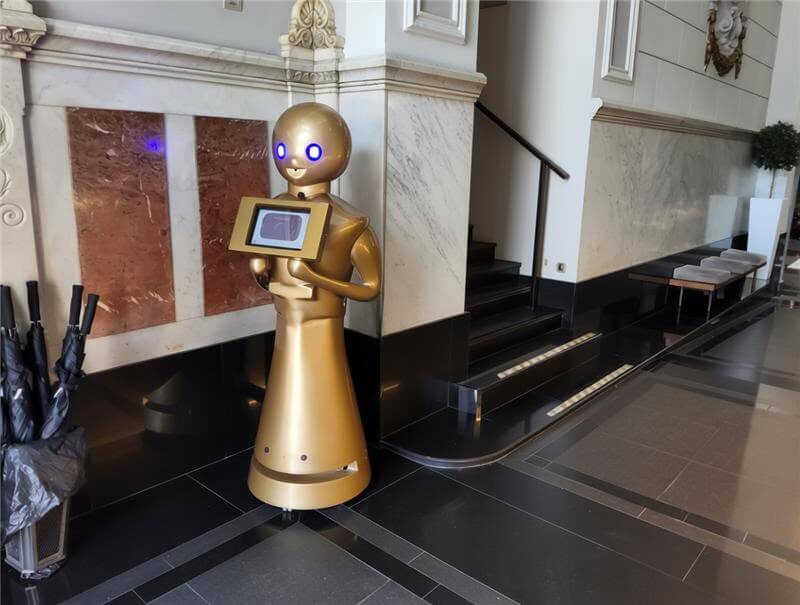
An innovative experiment developed in conjunction with the Universitat Jaume I with social robots at the Intur Orange hotel in Benicàssim: two robots called Tokyo (android) and Nairobi (human appearance) interact with customers, offer tourist information, greet and ask questions, all with a human-technological approach.
The goal: to evaluate how guests react to a robotic service, measure its acceptance, and understand what benefits it can bring to the hotel experience and tourism service.
In a sector as focused on customer experience as tourism, innovating with robots raises key questions: Do guests see robots as added value or as something cold and distant? Can these machines improve service without compromising human warmth?
The robots are placed in the hotel lobby, where they offer information about the hotel, the surroundings, local attractions, etc.
For two weeks, customers can freely interact with the robots. After the experience, their feedback is collected through questionnaires to analyze their perception.
The project combines academic research (UJI) with real-world application in the hotel industry, allowing for an in-depth study of the social and commercial impact.
Collection of qualitative data: guest impressions on usefulness, friendliness, and trust in robots.
First phase in a hotel in Madrid, second in Benicàssim: this allows for comparison of different contexts and customer profiles.
Potential for scaling: if the reception is positive, social robots could be incorporated into more hotels to improve the customer experience, reduce the operational burden on staff, and differentiate themselves through innovation.